Publications

Export 3823 results:
Ordenar por: Autor Título Tipo [ Ano  (Desc)]
2014
Cepik, M, CANABARRO D, BORNE T.  2014.  Securitização do Ciberespaço e o Terrorismo: Uma Abordagem Crítica. In: SOUZA, Andre; NASSER, Reginaldo M.; MORAES, Rodrigo F. [organizadores]. Do 11 de setembro de 2001 à guerra ao terror: reflexões sobre o terrorismo no século XXI. , Brasilia: IPEACEPIK, CANABARRO & BORNE (2014) Securitizacao Ciberespaco.pdf
Cepik, M, Jornada H.  2014.  Segurança Internacional: estrutura e risco político em mercados prioritários para o Brasil. In: CUNHA, Andre M.; HENKIN, Helio; LELIS, Marcos T. C. [organizadores]. A Internacionalização do Brasil na Era da Globalização. , Porto Alegre, RS: UFRGSCEPIK & JORNADA - 2014 - Seguranca Internacional Mercados Prioritarios Brasil.pdf
Moraes, JC, Beznosova O, Pereyra MC.  2014.  Sharp Bounds for t-Haar Multipliers on L^2. Contemporary Mathematics. 612(1):45-64.
Metz, FL, Rocchi J, Urbani P.  2014.  Statistical mechanics of the spherical hierarchical model with random fields. Journal of Statistical Mechanics. :P09018.
Bressan, F, Bruscato UM, da Costa DS, Teixeira FG, Oliveira DJL, da Silva TLK.  2014.  SUPERFÍCIES PARAMÉTRICAS: UMA APLICAÇÃO NO DESENHO DE EMBALAGENS PARA FRUTAS. 11º Congresso Brasileiro de Pesquisa e Desenvolvimento em DesignAnais do 11º Congresso Brasileiro de Pesquisa e Desenvolvimento em Design. :2400-., Gramado Abstract

n/a

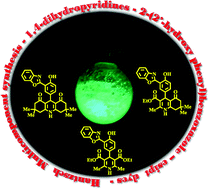
Affeldt, RF, de Borges ACA, Russowsky D, Rodembusch FS.  2014.  Synthesis and fluorescence properties of benzoxazole-1,4-dihydropyridine dyads achieved by a multicomponent reaction. New Journal of Chemistry. 38:4607-4614.
Brinkerhoff, RC, Tarazona HF, de Oliveira PM, Flores DC, D'Oca CDMR, Russowsky D, D'Oca MMG.  2014.  Synthesis of β-ketoesters from renewable resources and Meldrum's acid. RSC Advances. 4:49556-49559.
HABERMAS, J, SILVA FG.  2014.  Técnica e Ciência como 'Ideologia' (Tradução). , São Paulo: Ed. Unesp
Lopes, SRC, Prass TS.  2014.  Theoretical results on fractionally integrated exponential generalized autoregressive conditional heteroskedastic processes. Physica A: Statistical Mechanics and its Applications. 401:278-307. AbstractWebsite

Here we present a theoretical study on the main properties of Fractionally Integrated Exponential Generalized Autoregressive Conditional Heteroskedastic (FIEGARCH) processes. We analyze the conditions for the existence, the invertibility, the stationarity and the ergodicity of these processes. We prove that, if {Xt}t∈Z is a FIEGARCH(p,d,q) process then, under mild conditions, {ln(Xt2)}t∈Z is an ARFIMA(q,d,0) with correlated innovations, that is, an autoregressive fractionally integrated moving average process. The convergence order for the polynomial coefficients that describes the volatility is presented and results related to the spectral representation and to the covariance structure of both processes {ln(Xt2)}t∈Z and {ln(σt2)}t∈Z are discussed. Expressions for the kurtosis and the asymmetry measures for any stationary FIEGARCH(p,d,q) process are also derived. The h-step ahead forecast for the processes {Xt}t∈Z, {ln(σt2)}t∈Z and {ln(Xt2)}t∈Z are given with their respective mean square error of forecast. The work also presents a Monte Carlo simulation study showing how to generate, estimate and forecast based on six different FIEGARCH models. The forecasting performance of six models belonging to the class of autoregressive conditional heteroskedastic models (namely, ARCH-type models) and radial basis models is compared through an empirical application to Brazilian stock market exchange index.

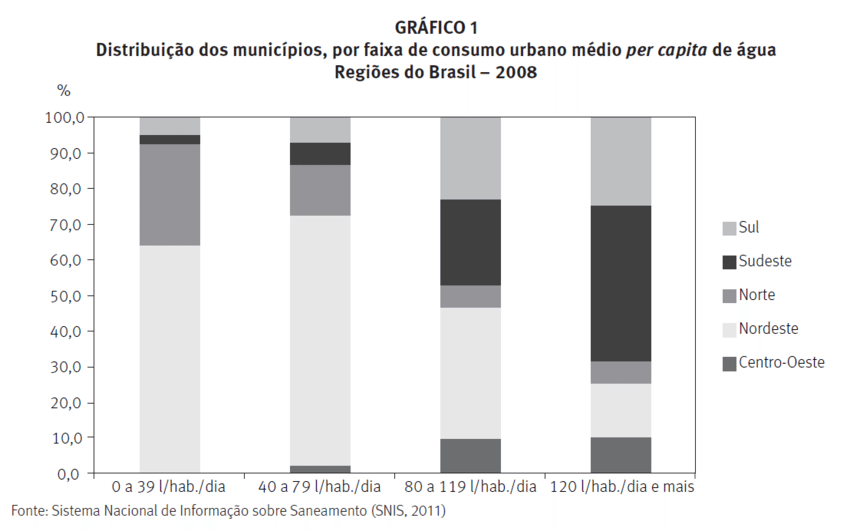
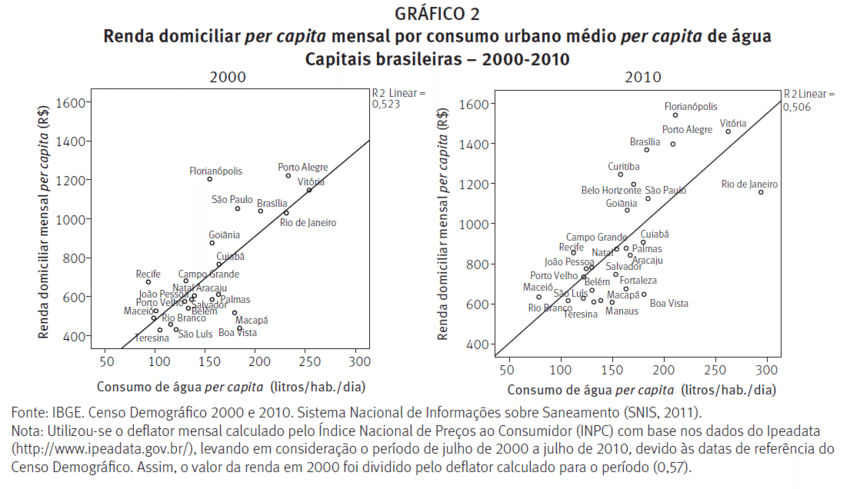
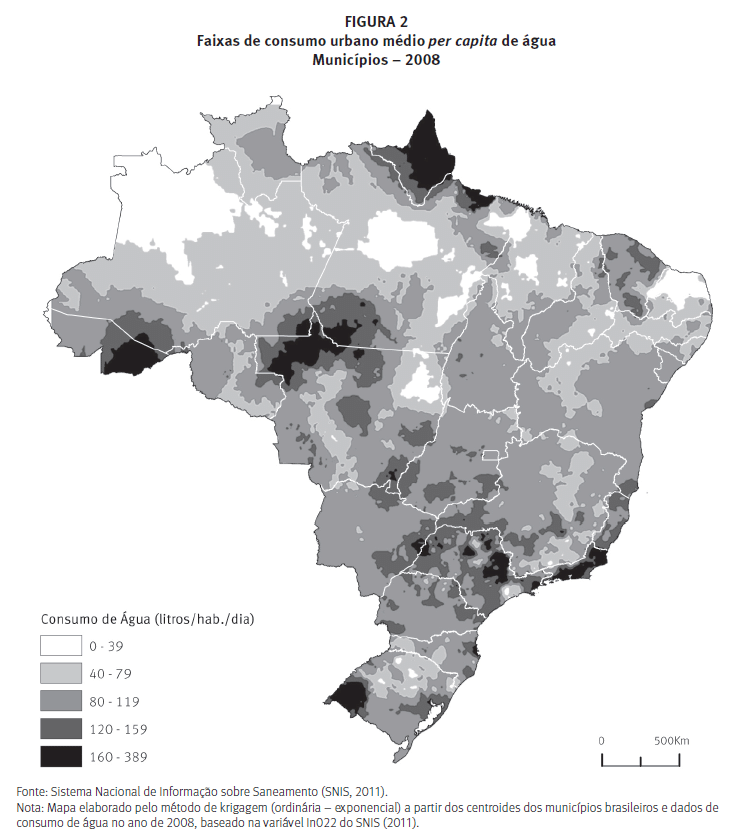
Carmo, RL, Dagnino R, Johansen IC.  2014.  Transição demográfica e transição do consumo urbano de água no Brasil. Revista Brasileira de Estudos de População. 31(1):169-190. Abstract2014_rebep_carmo_et_al_transicao_demografica.pdfScielo

Resumo:

Este artigo discute que, embora o volume da população seja um aspecto relevante a se considerar na relação entre população e ambiente, existem outros fatores que podem ser ainda mais importantes. Na perspectiva demográfica, elementos como a composição e distribuição espacial da população são fundamentais. Em termos ambientais, o estilo de desenvolvimento e o nível de consumo são decisivos. O Brasil vive um momento de transições flagrantes. Por um lado, existe a transição demográfica (queda nas taxas de mortalidade e natalidade), marcada pelo rápido declínio na taxa de fecundidade total, de cerca de 6 filhos por mulher, em 1960, para menos de 2 filhos, em 2010. Por outro lado, há uma transição de consumo, discutida neste trabalho tendo como referência a melhoria da situação econômica do país e o aumento do consumo de água, que é causado tanto pela expansão do sistema de abastecimento em áreas urbanas quanto pela tendência de aumento do gasto per capita. Assim, enquanto houve uma redução significativa das taxas de crescimento populacional, o consumo de água apresentou tendência de aumento, como resultado de alterações nos padrões de acesso e níveis de consumo.

Abstract:

In this paper we discuss that, although the volume of the population is an important aspect to be considered in the relationship between population and environment, there are other factors that may be even more important. From a demographic perspective, for example, details such as composition and spatial distribution of the population are essential. In environmental terms, the style of development and level of consumption are crucial. Brazil is going through a time of important transitions. On the one hand, the demographic transition (decreased levels of mortality and birth rates), is characterized by the rapid decline in total fertility rate, from about 6 children per woman in the 1960s to fewer than 2 children per woman in the late 2000s. On the other hand, there is a consumption transition also in course, discussed here in the relationship between improving the economic situation and increased water consumption, which is caused by the expansion of the supply system in urban areas and by the trend toward growing per capita consumption. Thus, while there has been a significant decrease in population growth rates, water consumption tends to increase as the result of changes in access patterns and consumption levels.

Resumen:

Este artículo discute que, aunque el volumen de la población sea un aspecto relevante a considerar en la relación entre población y ambiente, hay otros factores que pueden ser todavía más importantes. Desde la perspectiva demográfica, elementos como la composición y distribución espacial de la población son fundamentales. En lo que concierne al medio ambiente, el estilo de desarrollo y el nivel de consumo son decisivos. Brasil vive un momento de marcadas transiciones. Por un lado, existe la transición demográfica (baja en las tasas de mortalidad y natalidad), marcada por el rápido descenso en la tasa de fecundidad total, de cerca de 6 hijos por mujer, en 1960, para menos de 2 hijos, en 2010. Por otro lado, hay una transición de consumo, que se discute en este trabajo teniendo como referencia la mejora de la situación económica del país y el aumento del consumo de agua, que es ocasionado tanto por la expansión del sistema de abastecimiento en áreas urbanas como por la tendencia de aumento del gasto per cápita. De este modo, mientras hubo una reducción significativa de las tasas de crecimiento poblacional, el consumo de agua presentó una tendencia de aumento, como resultado de alteraciones en los estándares de acceso y niveles de consumo.

Blank, D, Pirito RMBK, Waksman RD, Gaspar VLV.  2014.  Trânsito e transporte de crianças e jovens. Crianças e adolescentes em segurança. , Barueri: Manoleblank_transito_2014.pdf
Domingues, FS.  2014.  Uma introdução à ética econômica e social. , Saarbrücken: Novas Edições Acadêmicasuma_introducao_a_etica_economica_e_social_pub.pdf
Waksman, RD, Pirito RMBK, Blank D.  2014.  Viagem com crianças e adolescentes. Crianças e adolescentes em segurança. , Barueri: Manoleblank_viagens_criancas_2014.pdf
Santos, DG, Ziegelmann FA.  2014.  Volatility Forecasting via MIDAS, HAR and their Combination: An Empirical Comparative Study for IBOVESPA. Journal of Forecasting. 33:284-299.
Giardino, S.  2014.  ``Axisymmmetric empty space: light propagation, orbits and dark matter''. J. Mod. Phys.. 5(15):1402-1411. AbstractWebsite

This study presents an axisymmetric solution of the Einstein equations for empty space. The geometry is studied by determining its Petrov classification and killing vectors. Light propagation, orbital motion and asymptotic and Newtonian limits are also studied. Additionally, cosmological applications of the geometry are also outlined as an alternative model for the inflationary universe and as a substitute for dark matter and quintessence.

Giardino, S, DeLeo S.  2014.  ``Dirac solutions for quaternionic potentials''. J. Math. Phys.. 55(2):022301-10. AbstractWebsite

The Dirac equation is solved for quaternionic potentials, i V0 + j W0 (V0∈ℝ,W0∈ℂ). The study shows two different solutions. The first one contains particle and anti-particle solutions and leads to the diffusion, tunneling, and Klein energy zones. The standard solution is recovered taking the complex limit of this solution. The second solution, which does not have a complex counterpart, can be seen as a V0-antiparticle or |W0|-particle solution.

Giardino, S.  2014.  ``The Static String''. Mod. Phys. Lett.. A29(03):1450018. AbstractWebsite

In this paper, the quantum fluctuation of a rigid and static string is reported to be identical to a free quantum particle. Solutions similar to this static string have already been found in the semiclassical quantization of pulsating strings, and our results show that the semiclassical quantization of pulsating strings is, in some cases, a perturbation of static strings. We also interpret the energy of the static string as a lower bound for the pulsating string and speculate about a description of quantum mechanics in terms of semiclassical string theory.

Alberton, CL, Pinto SS, Cadore EL, Kanitz AC, Delevatti RS, Pantoja P{\'ıciaD, Peyrè-Tartaruga LA, Colado JC, Kruel LFM.  2014.  Acute Effects Of Aerobic Exercises On The Subsequent Water-Based Resistance Exercises: 3504 Board\# 148 May 31, 930 AM-1100 AM. Medicine & Science in Sports & Exercise. 46:941., Number 5S: LWW Abstract
n/a
Gomeñuka, NA, Bona RL, da Rosa RG, Peyré-Tartaruga LA.  2014.  Adaptations to changing speed, load, and gradient in human walking: cost of transport, optimal speed, and pendulum. Scandinavian journal of medicine & science in sports. 24:e165–e173., Number 3 Abstract
n/a
Gomeñuka, NA, Bona RL, da Rosa RG, Peyré-Tartaruga LA.  2014.  Adaptations to changing speed, load, and gradient in human walking: Cost of transport, optimal speed, and pendulum. Scandinavian Journal of Medicine and Science in Sports. 24:e165-e173., Number 3 AbstractWebsite
n/a
Vendrusculo, AP, Alberton CL, Beltrame F, Maier J, Tartaruga LP, Pantoja P{\'ıcia D, Kruel LFM.  2014.  Análise de lesão muscular e comportamento do vo2máx entre um programa de treinamento de corrida em piscina funda e corrida em terra. Cinergis. 15, Number 2 Abstract
n/a
Eckhard, D, Campestrini L, Boeira E, Gomes da Silva Jr. JM.  2014.  Aplicação de métodos de controle baseado em dados em um sistema de controle de nível industrial. XVI Congreso Latinoamericano de Control Automático. :1410–1415., Cancún: AMCA Abstract

Os métodos de projeto de controladores baseado em dados são um conjunto de técnicas utilizadas para ajustar os ganhos de controladores, que não utilizam um modelo matemático do processo na sintonia dos parâmetros. Alguns destes métodos são o Iterative Feedback Tuning (IFT), Correlation based Tuning (CbT), Virtual Reference Feedback Tuning (VRFT) e Optimal Controller Identification (OCI). Apesar de algumas destas t{ écnicas existirem por mais de uma década, são encontrados poucos trabalhos na literatura que demonstram a aplicabilidade dos métodos em sistemas industriais. Neste trabalho duas técnicas de projeto de controladores baseado em dados não-iterativas (VRFT e OCI) são aplicadas em em um sistema de controle de nível industrial, que utiliza uma rede Foundation Fieldbus H1. O trabalho demostra que as técnicas apresentadas podem ser aplicadas com facilidade em sistemas industriais gerando repostas dinâmicas satisfatórias.