Dagnino, R.
2019.
População: Elementos demográficos para compreender o Brasil e suas transições. Brasil em números. 27(2019):71-89.
AbstractIdentificar os elementos demográficos que compõem o estado da população (estrutura, dimensão e distribuição espacial), as variáveis demográficas (natalidade, mortalidade, migrações) e as dinâmicas demográficas permite melhor compreender o Brasil e suas transições. Este texto baseia-se nos dados obtidos a partir dos últimos Censos Demográficos do Instituto Brasileiro de Geografia e Estatística (IBGE) e nos dados utilizados nas Projeções da População do IBGE - Revisão 2018 para esboçar um panorama atual sobre a população residente no País. Nas últimas décadas, a estrutura da população vem passando por alterações significativas decorrentes daquilo que os demógrafos costumam chamar de transição demográfica – um fenômeno social que apesar de afetar toda população brasileira, apresenta-se de maneira diferenciada, em função das desigualdades sociais e diversidades regionais – e que se manifesta na redução da mortalidade, seguida da diminuição na natalidade (CARMO; CAMARGO, 2018).
Dagnino, R.
2019.
Population: Demographic elements to understand Brazil and its transitions. Brazil in figures. 27(2019):70-89.
AbstractIdentifying the demographic elements that comprise the population status (structure, dimension and spatial distribution), the demographic variables (birth, mortality, migration) and the demographic dynamics allows us to better understand Brazil and its transitions. The present article – grounded on data based on the last Population Censuses of the Brazilian Institute of Geography and Statistics (IBGE) and on data used in the Population Projections of the IBGE - 2018 Review – intends to draw a current picture of the resident population in Brazil. Over the last decades, the population structure has been undergoing significant changes resulting from what demographers tend to describe as demographic transition – a social phenomenon that affects all the Brazilian population, although it can have many faces stemming from regional and social diversities. The phenomenon is materialized in the reduction of mortality followed by a drop in birth rates (CARMO; CAMARGO, 2018).
LUIZ, R, AMARAL H, Dagnino R, KALSING R.
2019.
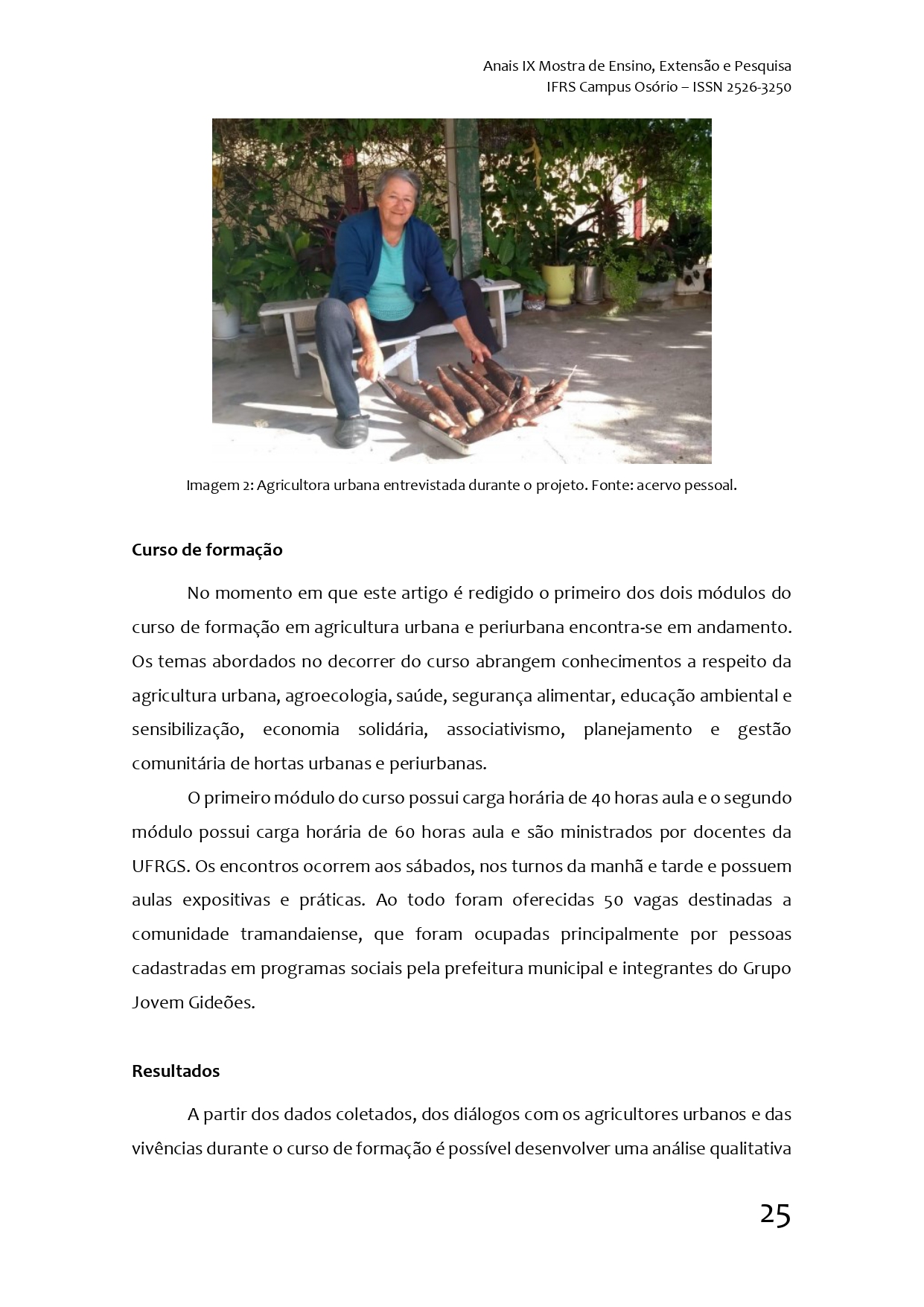
Projeto Hortas Urbanas e Periurbanas do Município de Tramandaí. 9ª Mostra de Ensino, Extensão e Pesquisa do Instituto Federal de Educação, Ciência e Tecnologia do Rio Grande do Sul - Campus Osório. :18-29., Osório, Rio Grande do Sul: Anais da 9ª MoExP - Mostra de Ensino, Extensão e Pesquisa do Instituto Federal de Educação, Ciência e Tecnologia do RioGrande do Sul - Campus Osório
AbstractA agricultura urbana, além promover a segurança alimentar e nutricional, é também uma forma de promoção da sociodiversidade cultural e de redução das condições de vulnerabilidades de grupos sociais. Conceber a agroecologia e a educação ambiental promove a melhoria das contribuições sociais, econômicas e ecológicas do sistema urbano. O projeto de extensão intitulado "Agricultura Urbana e Periurbana: alimentação, educação e saúde" busca integrar a Universidade Federal do Rio Grande do Sul às instituições municipais, organizações não governamentais e à sociedade civil em torno de um projeto interdisciplinar que objetiva promover a educação ambiental e a agroecologia, oferecer cursos teórico-práticos que envolvam temas voltados à agricultura urbana e periurbana, realizar um diagnóstico das hortas no município de Tramandaí, promover a segurança alimentar e nutricional; propor o planejamento e gestão das hortas comunitárias no município e proporcionar o empoderamento de grupos sociais vulneráveis. O projeto, iniciado em fevereiro de 2019, está em processo de execução e no momento possui duas frentes: a primeira delas é uma pesquisa de campo onde estão sendo mapeadas e caracterizadas, a partir de entrevistas semiestruturadas, as hortas urbanas no município de Tramandaí; a segunda é um curso de extensão que foi estruturado e está em processo de inscrições. Este possui dois módulos com carga horária de 40h, será ministrado por docentes da UFRGS e destinado à comunidade do município de Tramandaí, abordando conteúdos a respeito de técnicas de agricultura, saúde e segurança alimentar, educação e gestão comunitária. Os resultados parciais do mapeamento e caracterização das hortas urbanas demonstram que já existem agricultores urbanos que comercializam sua produção, também percebeu-se o desenvolvimento de técnicas de cultivo adaptadas às condições e espaços disponíveis. Além disto o perfil do indivíduo que cultiva no município é de pessoas acima dos 50 anos, estas destacam o caráter de sociabilidade proporcionado pelas hortas, que tornaram-se um espaço de convivência e troca com a comunidade.
 ]
]