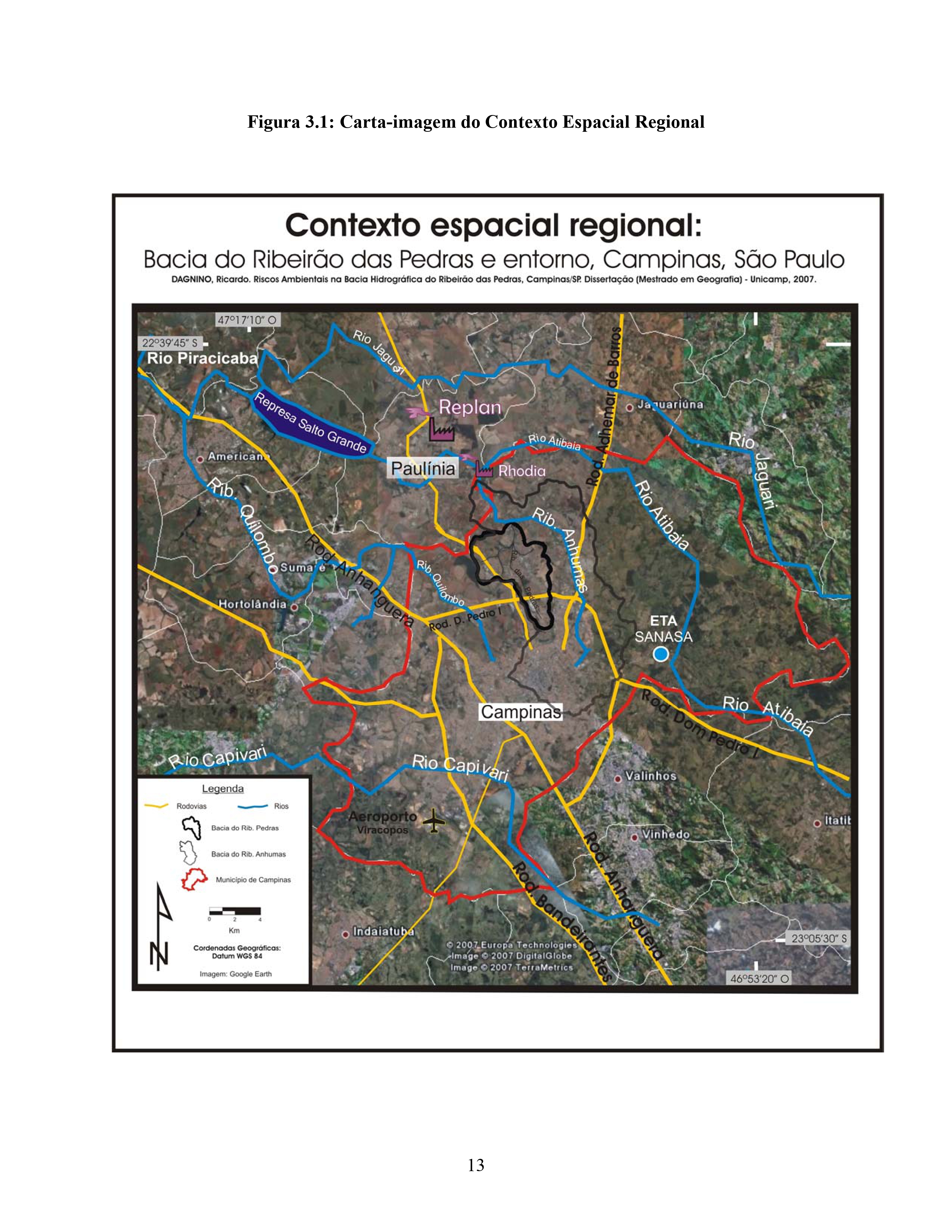
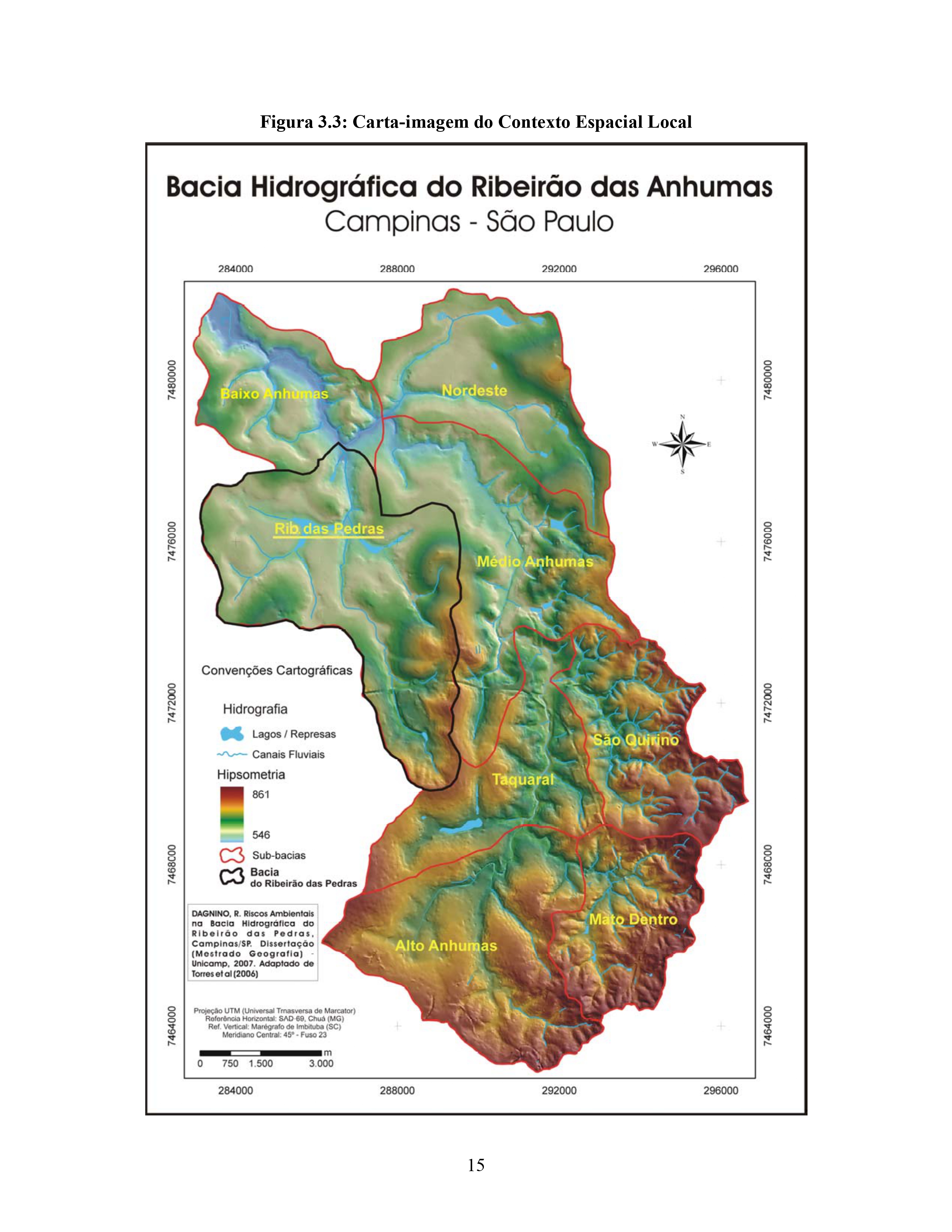
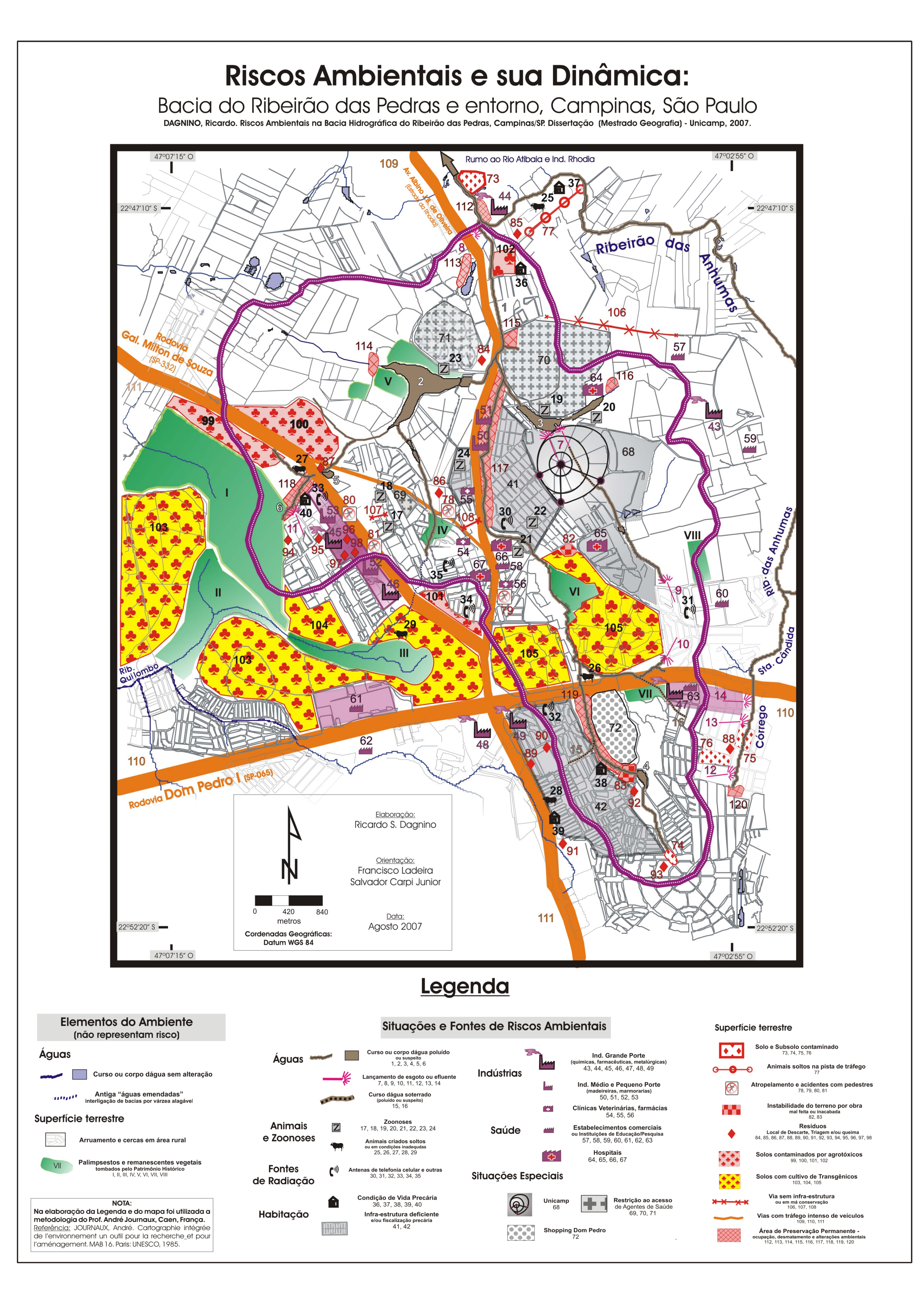
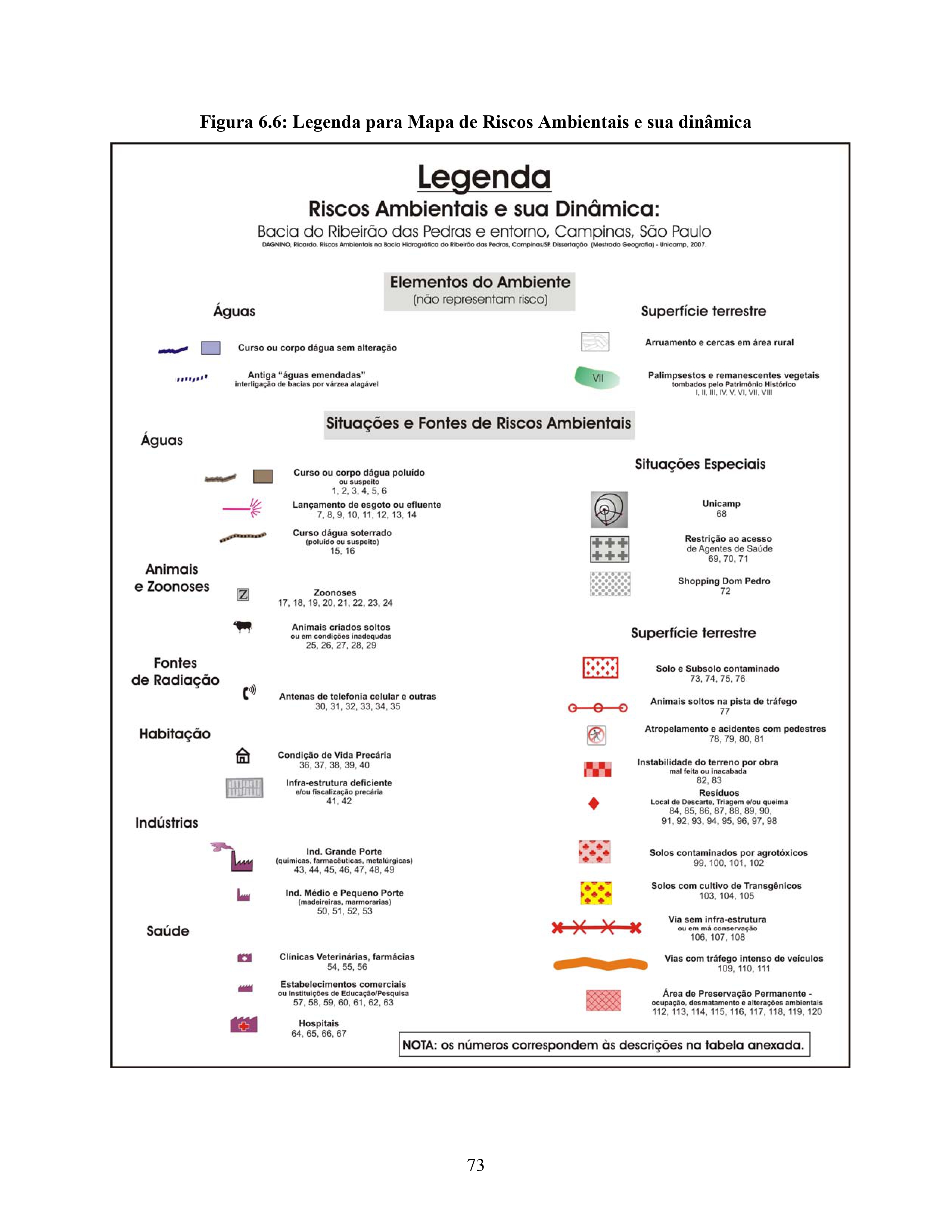
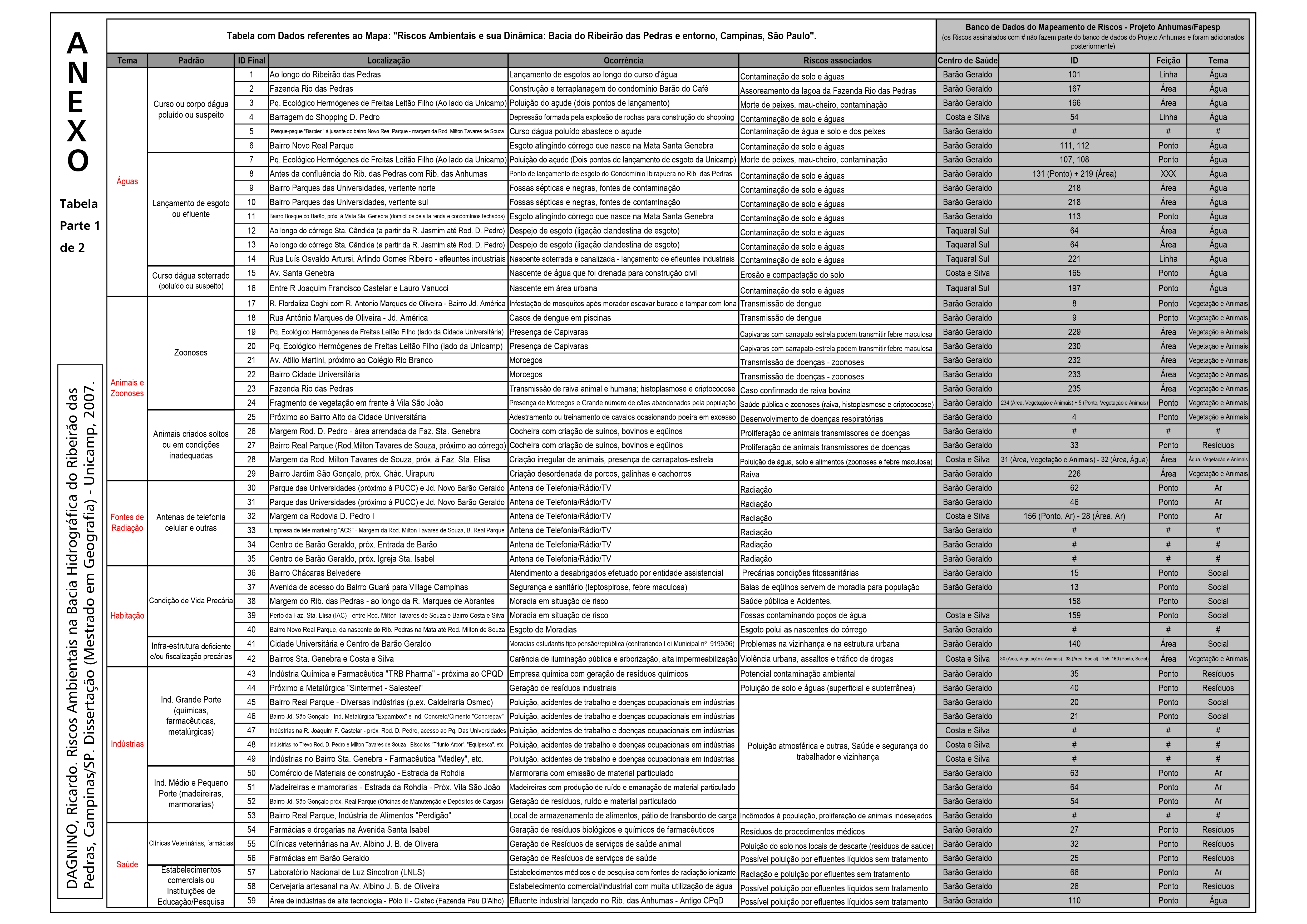
Resumo: Este trabalho trata dos riscos ambientais na Bacia Hidrográfica do Ribeirão das Pedras, uma importante sub-bacia do Ribeirão das Anhumas, no Município de Campinas, Estado de São Paulo. O Ribeirão das Pedras drena águas do Distrito de Barão Geraldo e dos Bairros Santa Genebra, Jardim Costa e Silva, Alto Taquaral, Jardim Primavera e outros. Nesta bacia se localizam os campi de diversas instituições de ensino e pesquisa como a Universidade Estadual de Campinas (Unicamp) e a Pontifícia Universidade Católica de Campinas, além de diversas indústrias e estabelecimentos comerciais de grande porte. Na área da bacia, 29,7 km2, residem cerca de 36 mil habitantes, totalizando mais de 1200 hab/km2. O mapa final, elaborado com base na representação proposta por Journaux (1985), utilizou dados adquiridos em trabalhos de campo, além de outros resultados do Projeto Anhumas ¿ FAPESP. Dentre o total de 120 situações de riscos mapeadas, os maiores, em área, foram identificados como riscos relacionados ao cultivo agrícola, com a utilização de agrotóxicos e o cultivo de Organismos Geneticamente Modificados (OGM), além das situações de riscos especiais, relacionados à presença da Unicamp e do Shopping Parque D. Pedro como as principais fontes de riscos da Bacia. Ao final, são feitas sugestões de continuidade para o estudo de riscos ambientais utilizando o mapeamento participativo de riscos e a proposta de cartografia elaborada com base em Journaux (1985).
Abstract: This work deals with the environmental risks at Ribeirão das Pedras, an important subwatershed of the Ribeirão das Anhumas watershed, at Campinas, São Paulo state. The Ribeirão das Pedras drains waters of the of Barão Geraldo district and the quarters called Santa Genebra, Jardim Costa e Silva, Alto Taquaral, Jardim Primavera and other quarters. In this basin is located universities, as the State University of Campinas (Unicamp) and the Pontifical University Catholic of Campinas, and big industries and commercial establishments. In this watershed live 36 thousand inhabitants, in one area like 29,7 km2, totalizing more than 1200 hab/km2. The final map, elaborated on the basis of the representation proposal for Journaux (1985), used data collected in fieldwork, and additional results of the Anhumas Project - FAPESP. Amongst the total of 120 mapped risk situations, the biggest, in area, was identified a risks related to plantation with agro-toxics and the culture of genetically modified organism (GMO). Moreover, the presence of the Unicamp and Dom Pedro Shopping, classified as special situation of risk, are related as the main sources of risks of the watershed. At the end, suggestions are made for the continuity of using the participatory risk mapping and the cartography elaborated on the basis of Journaux (1985) in other environmental risk studies
 ]
]