Publications

Export 178 results:
Ordenar por: Autor Título Tipo [ Ano  (Desc)]
Submitted
{Przygocki, LC, de Oliveira$^1$ V{\'ıcius M, Ferreira$^1$ C, Detoni$^1$ GC, Rosa SW, Sérgio B, Portela$^1$ MRQ$^1$, Tartaruga LAP.  Submitted.  RELA{\c{C}}ÃO ENTRE TRABALHO MECÂNICO E DESEMPENHO DE CORREDORES DE MEIA E LONGA DISTÂNCIAS. Abstract
n/a
2024
Altmann, S.  2024.  Realismo empírico em Kant. Estudos Kantianos. 10:159-174.
Abreu, E, Santo AE, Lambert W, Pérez J.  2024.  A relaxation approach to modeling properties of hyperbolic–parabolic type models. Communications in Nonlinear Science and Numerical Simulation. 133:107967. AbstractWebsite

In this work, we propose a novel relaxation modeling approach for partial differential equations (PDEs) involving convective and diffusive terms. We reformulate the original convection–diffusion problem as a system of hyperbolic equations coupled with relaxation terms. In contrast to existing literature on relaxation modeling, where the solution of the reformulated problem converges to certain types of equations in the diffusive limit, our formalism treats the augmented problem as a system of coupled hyperbolic equations with relaxation acting on both the convective flux and the source term. Furthermore, we demonstrate that the new system of equations satisfies Liu’s sub-characteristic condition. To verify the robustness of our proposed approach, we perform numerical experiments on various important models, including nonlinear convection–diffusion problems with discontinuous coefficients. The results show the promising potential of our relaxation modeling approach for both pure and applied mathematical sciences, with applications in different models and areas.

2023
Ricco, R, Ziegelmann FA.  2023.  Realized Semicovariances: Empirical Applications to Volatility Forecasting and Portfolio Optimization. Brazilian Review of Finance. 21(33):99-122.
Abreu, E, Ferraz P, Espírito Santo AM, Pereira F, Santos LGC, Sousa FS.  2023.  Recursive formulation and parallel implementation of multiscale mixed methods. Journal of Computational Physics. 473:111681. AbstractWebsite

Multiscale methods for second order elliptic equations based on non-overlapping domain decomposition schemes have great potential to take advantage of multi-core, state-of-the-art parallel computers. These methods typically involve solving local boundary value problems followed by the solution of a global interface problem. Known iterative procedures for the solution of the interface problem have typically slow convergence, increasing the overall cost of the multiscale solver. To overcome this problem we develop a scalable recursive solution method for such interface problem that replaces the global problem by a family of small interface systems associated with adjacent subdomains, in a hierarchy of nested subdomains. Then, we propose a novel parallel algorithm to implement our recursive formulation in multi-core devices using the Multiscale Robin Coupled Method by Guiraldello et al. (2018) [26], that can be seen as a generalization of several multiscale mixed methods. Through several numerical studies we show that the new algorithm is very fast and exhibits excellent strong and weak scalability. We consider very large problems, that can have billions of discretization cells, motivated by the numerical simulation of subsurface flows.

Carvalho, EM.  2023.  Resenha de Mitchell, Melanie. Artificial Intelligence: A guide for thinking humans. New York: Macmillan, 2019. Principia: an international journal of epistemology. 27(3):609-623.Website
Radomsky, G.  2023.  Retrato de uma vida em comunidade: o relato de si ante a duas modalidades de desenvolvimento. Desenvolvimento em Questão. 21(59):1-17.Website
Chen, Y, Torrent HS, Ziegelmann FA.  2023.  Robust Nonparametric Frontier Estimation in Two Steps. Econometric Reviews. 42(7):612-634.: Submitted
2022
Arellano-Perez, A, Alves J, De Oliveira Alvares L.  2022.  Re-exposures in the Dark Cycle Promote Attenuation of Fear Memory: Role of the Circadian Cycle and Glucocorticoids. Neuroscience.
Matte, LP, Thill AS, Lobato FO, Novôa MT, Muniz AR, Poletto F, Bernardi F.  2022.  Reduction‐Driven 3D to 2D Transformation of Cu Nanoparticles. Small. 18:2106583.
Berriel, GP, Cardoso AS, da Silva ES, Schons P, Melo OUM, Bernardo RT, Fritsch CG, Ferreira NS, Kruel LFM, Peyré-Tartaruga LA.  2022.  Relationship between knee extensor and flexor muscle strength and age in professional volleyball players. Sports Biomechanics. AbstractWebsite
n/a
Berriel, GP, Peyré-Tartaruga LA, Lopes TR, Schons P, Zagatto AM, Sanchez-Sanchez J, Ramirez-Campillo R, Nakamura FY.  2022.  Relationship between vertical jumping ability and endurance capacity with internal training loads in professional volleyball players during preseason. Journal of Sports Medicine and Physical Fitness. 62:317-323., Number 3 AbstractWebsite
n/a
2021
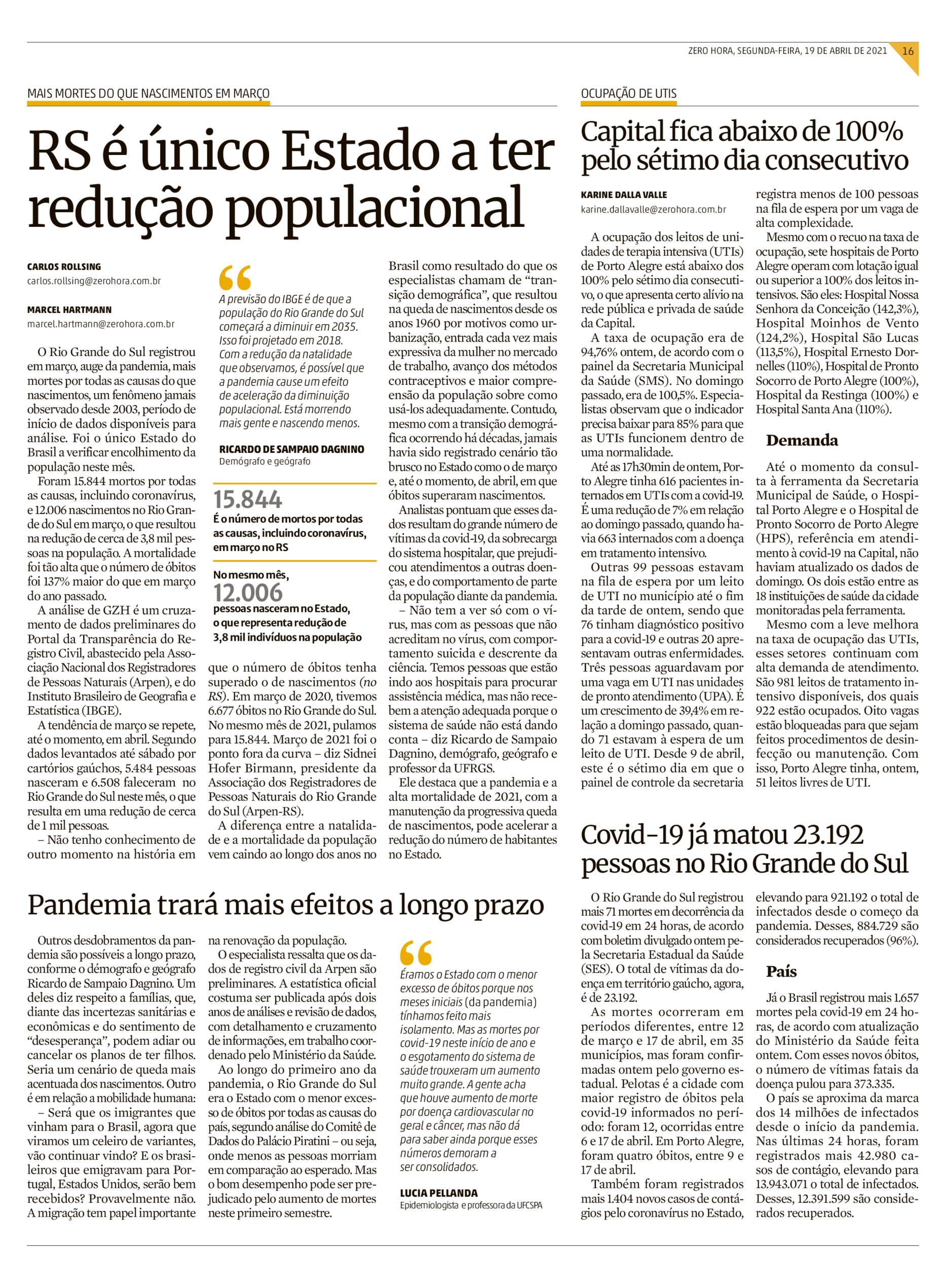
ROLLSING, C, HARTMANN M, Dagnino R.  2021.  RS é único Estado a ter redução populacional, 19/04/2021. Zero Hora. :16.
Acutain, MF, Luft J, Popik B, De Oliveira Alvares L, Baez MV.  2021.  Reduced Expression of Hippocampal GluN2A-NMDAR Increases Seizure Susceptibility and Causes Deficits in Contextual Memory. Frontiers in Neuroscience.
Schons, P, da Silva ES, Coertjens M, Oliveira HB, Fischer G, Costa RR, Preissler AAB, Knorst MM, Peyré-Tartaruga LA.  2021.  The relationship between height of vertical jumps, functionality and fall episodes in patients with chronic obstructive pulmonary disease: A case-control study. Experimental Gerontology. 152 AbstractWebsite
n/a
Berton, DC, Gass R, Feldmann B, Plachi F, Hutten D, Mendes NBS, Schroeder E, Balzan FM, Peyré-Tartaruga LA, Gazzana MB.  2021.  Responses to progressive exercise in subjects with chronic dyspnea and inspiratory muscle weakness. Clinical Respiratory Journal. 15:26-35., Number 1 AbstractWebsite
n/a
ROLLSING, C, HARTMANN M, Dagnino R.  2021.  RS é único Estado a ter redução populacional. Zero Hora. Abstract
n/a
2020
Dagnino, R.  2020.  Resultado da avaliação do curso de graduação em Desenvolvimento Regional da UFRGS: comentários sobre os indicadores que receberam nota 3 pelos avaliadores do INEP/MEC, 22/04/2020. :5., Tramandaí: Universidade Federal do Rio Grande do Sul - Campus Litoral Norte Abstractdagnino_2020_comentarios_avaliacao_inep_mec_desreg.pdf

Entre os dias 04/03/2020 a 07/03/2020, o curso de graduação em Desenvolvimento Regional da Universidade Federal do Rio Grande do Sul sediado no Campus Litoral Norte, Tramandaí, Rio Grande do Sul, recebeu a visita de Reconhecimento presencial por parte dos avaliadores do Instituto Nacional de Estudos e Pesquisas Educacionais Anísio Teixeira (INEP) do Ministério da Educação: Prof. Evandro de Araújo Jardini (Instituto Federal de Educação, Ciência e Tecnologia de São Paulo) coordenador da comissão e Profa. Mirella Caetano de Souza (Instituto Federal de Educação, Ciência e Tecnologia de São Paulo).

Enquanto membro da Comissão de Graduação do Desenvolvimento Regional e do Núcleo de Avaliação da Unidade da UFRGS Litoral (https://www.ufrgs.br/naulitoral/) participei ativamente do processo de avaliação.
Ao final, o curso de graduação em Desenvolvimento Regional recebeu nota 5, a nota máxima nesse tipo de avaliação. Essa nota é o resultado arredondado das casas decimais para cima do cálculo da média aritmética das notas de cada item. Felizmente a maior parte das notas foi em valores entre 4 e 5, o que fez que a média ficasse em 4,6 e finalmente, após o arredondamento, a nota final foi 5.

Entretanto, alguns itens avaliados tiveram nota 3 e 4, e merecem atenção para que se busque sanar possíveis falhas ou carências que ficaram expressas nessas notas mais baixas do que a média.
Dessa forma, este material busca cruzar o resultado obtido na avaliação do curso de graduação em Desenvolvimento Regional (DR) cujos resultados estão detalhados no Relatório de Avaliação (INEP, 2020) com as definições e conceitos contidos no instrumento de avaliação utilizado para a avaliação (INEP, 2017).

As notas que receberam nota 3 e que são objeto deste relatório são:
1. Vagas – número de vagas e monitoramento;
2. Atuação e regime de trabalho do coordenador do curso;
3. Produção científica do corpo docente.

Ladeia, CA, Bodmann BEJ, Vilhena MT.  2020.  Radiative–conductive transfer equation in spherical geometry: arithmetic stability for decomposition using the condition number criterion. Journal of Engineering Mathematics. 123:149-163. Abstract

n/a

Rui, K, Barichello LB, da Cunha RD.  2020.  Recent Studies on Two-Dimensional Radiative Transfer Problems in Anisotropic Media. Journal of Computational and Theoretical Transport. 49:233-266.
Arellano Perez, AD, Popik B, De Oliveira Alvares L.  2020.  Rewarding information presented during reactivation attenuates fear memory: Methylphenidate and fear memory updating. Neuropharmacology.