Pimentel, SP, Shiota R, Cirano FR, Casarin RCV, Pecorari VGA, Casati MZ, Haas AN, Ribeiro FV.
2018.
Occurrence of peri-implant diseases and risk indicators at the patient and implant levels: A multilevel cross-sectional study, Sep. J Periodontol. 89:1091-1100., Number 9
AbstractBACKGROUND: High prevalence rates of peri-implant diseases have been reported; however, the lack of standardization of definition criteria has lead to variations in the observed estimates. In addition, scarce data are available concerning patient and implant related factors associated to peri-implantitis. The aim of this study was to determine the prevalence of peri-implant diseases and their risk indicators at the patient and implant levels. METHODS: One hundred forty-seven patients with 490 dental implants were included. Dental implants were clinically and radiographically evaluated to determine their peri-implant conditions. Patient-related conditions and implant and prosthetic-related factors were recorded. Multivariable Poisson regression was fitted and prevalence ratios (PR) were reported. RESULTS: 85.3% of implants (95%CI 80.2 to 90.4) had mucositis and 9.2% (95%CI 4.7 to 13.7) had peri-implantitis. 80.9% (95%CI 73.8 to 86.8), and 19.1% (95%CI 12.6 to 25.5) of patients had mucositis and peri-implantitis. At the patient level, it was observed an increased probability of peri-implantitis in individuals with pocket depths >/=6 mm (PR = 2.47) and with >/=4 implants (PR = 1.96). Smoking increased the probability of peri-implantitis by three times (PR = 3.49). The final multilevel Poisson regression model at the implant level indicated that platform switching reduced the probability of peri-implantitis (PR = 0.18) and implants in function for >/=5 years increased this probability (PR = 2.11). The final model including patient and implant level indicators demonstrated that higher time of function (PR = 2.76) and smoking (PR = 6.59) were associated with peri-implantitis. CONCLUSION: Peri-implant diseases are highly prevalent in the studied sample, and factors associated with the occurrence of peri-implantitis were presence of pockets >/=6 mm, smoking, time of function, and type of platform.
Saffi, MAL, Rabelo-Silva ER, Polanczyk CA, Furtado MV, Montenegro MM, Ribeiro IWJ, Kampits C, Rosing CK, Haas AN.
2018.
Periodontal therapy and endothelial function in coronary artery disease: A randomized controlled trial, Oct. Oral Dis. 24:1349-1357., Number 7
AbstractOBJECTIVE: To assess the effects of periodontal treatment on endothelial function in patients with coronary artery disease. MATERIALS AND METHODS: A randomized controlled trial was conducted with 69 patients with stable coronary disease and severe periodontitis. The test group received nonsurgical periodontal therapy consisting of personalized oral hygiene instructions, subgingival scaling, and root planing per quadrant, whereas the control group received equal treatment after the study period. Endothelial function was assessed by measurement of brachial artery flow-mediated dilation, concentrations of sVCAM-1, sICAM-1, and P-selectin in serum before and 3 months after periodontal therapy. RESULTS: The test group exhibited statistically better periodontal parameters-plaque, probing depth, periodontal attachment loss, and bleeding on probing. No significant improvements were observed in the control (1.37%) and test (1.39%) groups in flow-mediated dilation, with no significant between-group difference. sVCAM-1 concentration increased in the control group (997.6 +/- 384.4-1201.8 +/- 412.5; p = 0.03), whereas in the test group, no significant changes were observed (915.1 +/- 303.8-1050.3 +/- 492.3; p = 0.17), resulting in a significant difference between the two groups (p = 0.04). The same pattern was observed for concentrations of sICAM-1. CONCLUSION: Periodontal treatment did not provide better vasodilation in patients with coronary disease in a short-term follow-up period, although it maintained blood concentrations of markers of vascular inflammation.
Santos, P, Dagnino R.
2018.
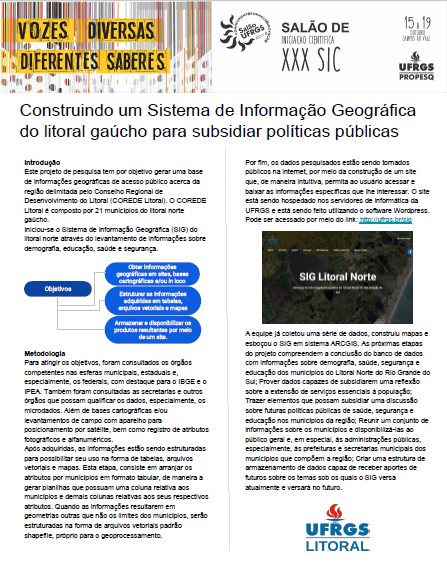
Construindo um sistema de informação geográfica do litoral gaúcho para subsidiar políticas públicas. XXX Salão de Iniciação Científica da UFRGS. , Porto Alegre - RS
AbstractEsta proposta de pesquisa tem por objetivo gerar uma base de informações geográficas de acesso público acerca da região delimitada pelo Conselho Regional de Desenvolvimento do Litoral (COREDE Litoral). O COREDE Litoral é composto por 21 municípios do litoral norte gaúcho. Pretende-se iniciar este projeto de informações geográficas do litoral norte, através do levantamento de informações sobre demografia, educação, saúde e segurança. Para isso a pesquisa pretendeu obter informações geográficas em sites, bases cartográficas e/ou in loco; Estruturar as informações adquiridas em tabelas, arquivos vetoriais e mapas e assim armazenar e disponibilizar os produtos resultantes por meio de um site.
 ]
]